



Most businesses do not think much about their network until something stops working.
An employee cannot connect to WiFi. A VoIP phone starts cutting out. Security cameras randomly disconnect. A workstation feels slow even though the company pays for fast internet. A new office addition suddenly needs more network drops, switches, access points, and equipment than anyone planned for.
These problems often get blamed on the internet provider, the computers, or the individual devices.
But many of them start with something more fundamental: poor network design.
A well-designed business network is more than a collection of cables and switches. It is the foundation that supports your internet connection, computers, cloud applications, business phone system, printers, wireless devices, cameras, access control, backups, and other technology.
At Unify Marketing & Technology Solutions, we help businesses throughout Maumee, Toledo, Northwest Ohio, and Southeast Michigan build network infrastructure that is reliable, organized, secure, and ready to grow.
Here is why network design matters more than most people realize.
Network Design Is the Foundation of Your Technology
Think of your business network like the road system around a city.
You can have fast vehicles, modern buildings, and plenty of resources, but if every road funnels into one poorly designed intersection, traffic problems are inevitable.
Your network works the same way.
Internet service enters your building and moves through your firewall, switches, network wiring, wireless access points, and other equipment before reaching employees and devices.
Every part of that path matters.
Good network design considers questions such as:
- How many employees and devices need connectivity?
- Where are computers, phones, printers, and other devices located?
- How many wireless access points are required?
- Will phones, cameras, and computers share the same network?
- Does equipment require Power over Ethernet?
- How should traffic be separated?
- How much growth should the network support?
- Where should switches and network closets be located?
- What happens if one network component fails?
Planning these details early can prevent many common network problems later.
Fast Internet Does Not Fix a Poorly Designed Network
One of the most common misconceptions is that increasing internet speed will automatically make the business network faster.
Sometimes it helps.
But if the internal network is the bottleneck, upgrading the internet connection may make little difference.
Poor cabling, damaged jacks, overloaded wireless access points, outdated switches, configuration problems, and poorly planned network layouts can all reduce performance.
That is why a complete network design should look at the entire environment rather than focusing only on the internet connection.
As we discuss in our article Why Fast Internet Doesn’t Fix a Bad Network, issues inside the building can create slow speeds and unreliable connectivity even when the internet service itself is working correctly.
Network Wiring Is Part of the Design
The physical wiring behind your network often gets overlooked because much of it is hidden above ceilings, inside walls, or behind equipment.
However, good network design starts with a reliable physical foundation.
A professional network wiring service should consider more than simply getting a cable from point A to point B.
Proper cabling should include:
- Appropriate cable types
- Proper terminations
- Organized patch panels
- Clean network racks
- Proper cable management
- Clearly labeled connections
- Testing and certification
- Logical routes through the building
- Room for future expansion
UNIFY provides professional network cabling services that support business networks, VoIP systems, wireless access points, security cameras, access control systems, and other connected devices.
Poor cabling can result in slow network speeds, packet loss, intermittent connections, and unnecessary troubleshooting.
A good network wiring service helps eliminate those problems before they start.
Good Network Design Makes Troubleshooting Easier
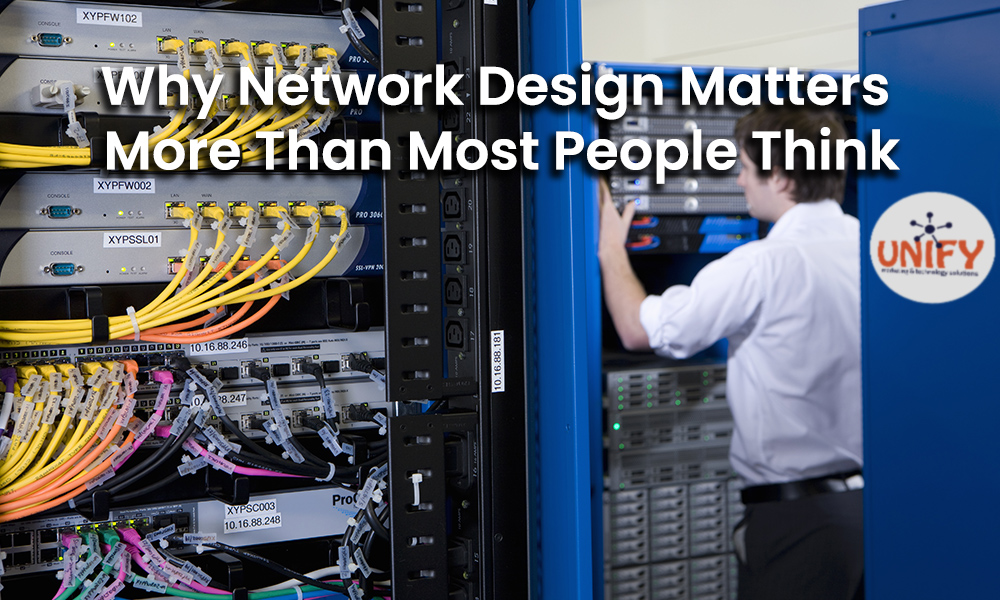
Imagine opening a network closet and finding dozens of unlabeled cables running in every direction.
Some are plugged in.
Some are not.
Nobody knows where half of them go.
A switch was added three years ago, another was added last year, and several temporary cables somehow became permanent.
This is a common situation in businesses that have grown gradually without a long-term infrastructure plan.
When something goes wrong, troubleshooting becomes unnecessarily difficult.
A technician may need to trace cables manually, determine which switch serves which area, locate undocumented devices, and figure out which connections are still active.
Organized network design makes troubleshooting much faster.
Proper labeling, documentation, rack organization, and structured cabling services allow technicians to quickly understand how the network is connected.
That means less downtime and less time spent trying to determine how the network was assembled.
Wireless Networks Still Depend on Wired Infrastructure
WiFi may feel wireless to employees, but the network behind it is not.
Most business wireless access points connect back to switches through Ethernet cabling.
That means WiFi performance depends heavily on proper network design.
Access points must be placed correctly, connected properly, and provided with enough network capacity.
Installing one wireless access point in the center of a large office and hoping it covers everything is rarely a good strategy.
Walls, building materials, equipment, distance, interference, and the number of connected devices can all affect wireless performance.
A professional network plan considers where employees work, how devices move throughout the building, and where coverage is actually needed.
The wired infrastructure then supports those wireless access points through professionally installed cabling services.
VoIP Phone Systems Depend on Good Network Design
Modern business phone systems commonly operate over the network.
That means voice traffic competes with computers, cloud applications, file transfers, security cameras, and other network activity.
Poor network design can create problems such as:
- Choppy audio
- One-way audio
- Delayed conversations
- Dropped calls
- Phones losing registration
- Inconsistent call quality
A properly designed network can separate voice traffic using VLANs and prioritize important traffic using Quality of Service settings.
UNIFY has implemented these types of configurations for businesses using cloud phone systems, including network segmentation and traffic prioritization designed to improve reliability.
If your company depends on VoIP, the network supporting the phone system matters just as much as the phone system itself.
Network Design Supports Better Security
Good network design is not only about speed.
It also plays an important role in cybersecurity.
A poorly planned network may place every device on the same network segment.
That can mean computers, printers, phones, cameras, guest devices, and other equipment all communicate within the same environment.
A better approach may separate different types of devices using network segmentation.
For example:
- Business computers may use one network
- VoIP phones may use another
- Security cameras may use another
- Guest WiFi may remain isolated
- Access control equipment may be separated from general user traffic
This can improve security, organization, and troubleshooting.
UNIFY’s infrastructure services combine structured cabling, network equipment, wireless connectivity, and network security planning to create a stronger technology foundation.
The physical network and cybersecurity strategy should work together.
Poor Design Becomes More Expensive as the Business Grows
A small office may be able to get by with an improvised network for a while.
Then the company grows.
Five employees become fifteen.
A second section of the building opens.
Security cameras are added.
A cloud phone system is installed.
More wireless devices appear.
Suddenly the network that once seemed adequate becomes difficult to manage.
This is where poor network design becomes expensive.
Businesses may end up adding switches wherever an available outlet exists, running temporary cables across offices, installing wireless extenders, or repeatedly calling technicians to solve isolated problems.
Each fix may solve today's problem while making the overall network more complicated.
A scalable design takes future growth into account.
You do not necessarily need to install everything immediately, but the infrastructure should make expansion easier when the time comes.
Cabling Services Matter During Office Moves and Renovations
Moving into a new building or remodeling an existing space is one of the best times to think carefully about network infrastructure.
Once walls and ceilings are finished, adding cabling can become more complicated.
Before construction is complete, businesses should consider where they will need:
- Workstations
- Desk phones
- Wireless access points
- Printers
- Security cameras
- Access control readers
- Conference room equipment
- Network closets
- Servers
- Digital signage
- Other connected equipment
Professional cabling services allow the network infrastructure to be planned alongside the physical workspace.
For businesses building or renovating offices in Maumee, Toledo, Perrysburg, Sylvania, Bowling Green, or other communities throughout Northwest Ohio, planning cabling early can save significant trouble later.
The same applies to businesses across Southeast Michigan that are expanding offices, warehouses, medical facilities, manufacturing spaces, or other commercial properties.
Your Network Closet Is Part of Network Design
The network closet is another area that often receives very little attention.
Yet it may contain some of the most important equipment in the business.
Firewalls, switches, internet equipment, patch panels, battery backups, phone equipment, and other systems may all live there.
Poor airflow, tangled cables, stacked equipment, unlabeled ports, and inadequate power protection can create reliability problems.
As covered in our article Why Your Network Closet Should Not Feel Like a Sauna, organized cabling, proper airflow, documented connections, and reliable equipment placement are all important parts of maintaining network infrastructure.
A clean network closet is not just about appearance.
It makes the network easier to maintain, upgrade, and troubleshoot.
Signs Your Network Design May Need Attention
Businesses do not always need a complete network replacement.
Sometimes a review of the existing infrastructure can identify specific improvements.
Warning signs may include:
- Frequent internet complaints
- WiFi dead zones
- Random device disconnects
- Unreliable VoIP calls
- Old or damaged network wiring
- Multiple unmanaged switches
- Messy network closets
- Unlabeled cables
- Temporary cables used permanently
- Difficulty locating network equipment
- Frequent support calls for connectivity
- Cameras or access control devices randomly going offline
These problems may indicate that the underlying network has grown beyond its original design.
Poor cabling is another common source of recurring network problems. Our article How Poor Cabling Causes Network Problems explains how damaged, outdated, or disorganized wiring can affect everything from computers to phones and security systems.
Build the Network Around the Business
Every business has different requirements.
A small professional office does not need the same network as a warehouse, manufacturing facility, medical office, school, or multi-building campus.
That is why good network design starts with understanding how the business actually operates.
What devices are used?
How many people need wireless access?
Are phones cloud-based?
Are cameras connected to the network?
Does the building have access control?
Are there remote employees?
Will the company expand?
What happens if a network device fails?
The answers help determine the proper cabling, switches, firewalls, wireless equipment, segmentation, and overall network architecture.
For businesses throughout Maumee, Toledo, Northwest Ohio, and Southeast Michigan, UNIFY can help evaluate existing infrastructure or plan a new network from the beginning.
Our network cabling services include structured cabling, rack and patch panel organization, data drops, fiber cabling, workstation connections, server room wiring, and infrastructure expansion.
A Better Network Starts With Better Planning
Most employees never see the cables, switches, patch panels, or network configuration that keep their technology running.
They simply expect everything to work.
That is exactly why network design matters.
A properly designed network creates a foundation that supports reliable internet, business phones, WiFi, cloud applications, computers, cameras, access control, and future technology upgrades.
Professional cabling services help make that design physically reliable, while an experienced network wiring service ensures devices are connected through organized, tested, and scalable infrastructure.
Businesses that plan their networks carefully often spend less time dealing with connectivity problems and more time using technology the way it was intended.
If your network has grown slowly over the years, or if you are planning a new office, renovation, expansion, or technology upgrade, it may be worth looking at the infrastructure behind everything first.
A better network usually starts long before anyone plugs in a computer.
Frequently Asked Questions
What is network design?
Network design is the process of planning how computers, switches, firewalls, wireless access points, phones, servers, cameras, and other devices connect and communicate. Good network design considers performance, security, reliability, scalability, and future growth.
Why is network design important for small businesses?
Small businesses depend heavily on internet connectivity, cloud applications, phones, computers, and wireless devices. Proper network design helps those systems operate reliably while making future expansion and troubleshooting easier.
What does a network wiring service include?
A professional network wiring service can include installing Ethernet or fiber cabling, data drops, wall jacks, patch panels, network racks, cable management, testing, labeling, and connections for computers, phones, wireless access points, cameras, and other devices.
What are cabling services?
Cabling services include the design, installation, testing, organization, repair, and expansion of structured network wiring used for data, voice, video, security, and other business systems.
Can poor network design cause slow internet?
Yes. Your internet provider may deliver the advertised speed to your building, but outdated switches, damaged cabling, poor WiFi coverage, network congestion, or configuration problems can make the connection feel much slower to employees.
Does network design affect VoIP phone quality?
Yes. VoIP phones depend on the business network. Proper VLAN configuration, Quality of Service settings, reliable cabling, switches, and internet connectivity can all affect call quality.
When should a business upgrade its network wiring?
Businesses should consider a network wiring upgrade when cabling is damaged, outdated, unlabeled, poorly organized, or unable to support current equipment. Office moves, renovations, expansions, new WiFi systems, VoIP installations, and security system projects are also good times to evaluate the wiring.
Does UNIFY provide network cabling services in Northwest Ohio?
Yes. UNIFY provides network infrastructure and cabling services for businesses in Maumee, Toledo, and throughout Northwest Ohio, along with service to businesses in Southeast Michigan.