


Knowing who can enter your building is important.
Knowing who actually entered it can be even more valuable.
Modern door access control systems do more than replace keys with cards, fobs, PINs, or mobile credentials. They can also create a record of activity that helps business owners and managers better understand who accessed a door, when access occurred, and which credential was used.
That activity history, often referred to as an entry log or access log, can become an important part of your overall security strategy.
At Unify Marketing & Technology Solutions, we help businesses throughout Maumee, Toledo, Perrysburg, Sylvania, Northwest Ohio, and Southeast Michigan implement access control and physical security solutions designed around their facilities and day-to-day operations.
When properly configured, entry logs can improve accountability, simplify security investigations, support employee management, and make it easier to respond when something unusual happens.
Here is why those logs matter and how they help protect your business.
What Is an Entry Log?
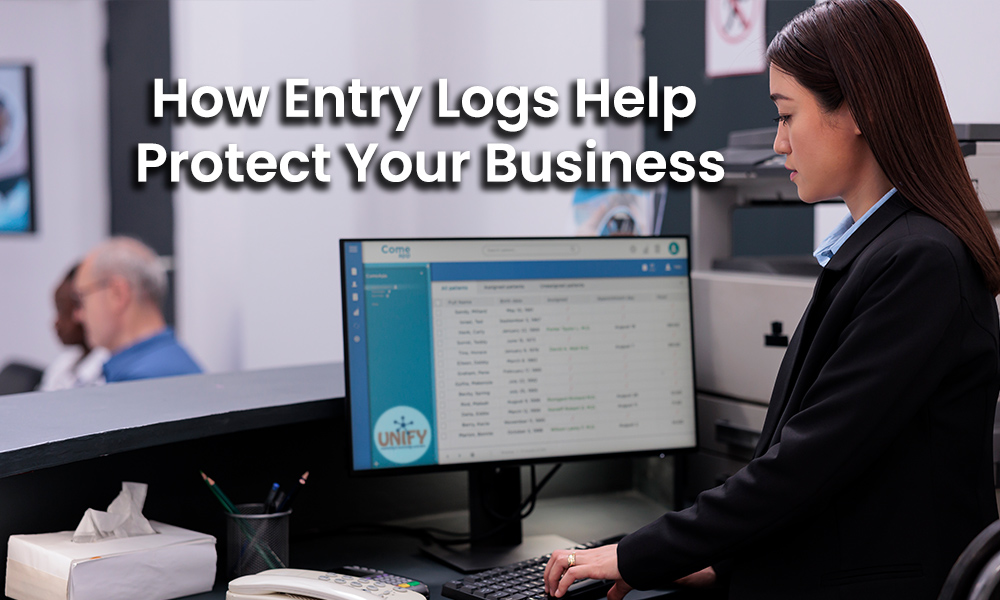
An entry log is a record created when someone interacts with an access-controlled door.
Depending on the system, the log may include information such as:
- The credential used
- The employee or user associated with that credential
- The door or entry point
- The date and time
- Whether access was granted or denied
- Administrative changes
- Other door activity
Modern access control systems can record building entry activity and allow administrators to review who accessed specific areas.
This creates a level of visibility that traditional keys simply cannot provide.
If someone uses a mechanical key to unlock a door at 8:15 p.m., there is usually no automatic record showing who did it. With door access control systems, the credential event can be logged automatically.
Entry Logs Add Accountability
Accountability is one of the biggest benefits of access control. When employees know that access to restricted areas is tracked, it becomes easier to maintain clear security policies.
For example, imagine that only five employees should have access to an inventory room.
If inventory goes missing, management can review the entry history and determine which credentials were used during the relevant timeframe. That does not automatically prove who caused the loss, but it can significantly narrow the investigation.
Entry logs can also help answer questions like:
- Who opened the office after hours?
- Which employee entered a storage room?
- Was someone denied access to a restricted door?
- What time was a building opened?
- Was a former employee's credential still used?
- Which credential accessed the server room?
This kind of information makes access control systems useful for much more than simply unlocking doors.
Entry Logs Can Help With Security Investigations
When something happens inside a business, reconstructing the timeline can be difficult.
Maybe equipment disappears from a warehouse.
Maybe someone enters a restricted office.
Maybe a door is found unlocked after hours.
Maybe an employee claims they were never inside a certain area.
Entry logs can provide another source of information.
If a security incident occurred at 6:30 p.m., management can review access activity around that time.
For example:
- Credential A entered Door 3 at 6:12 p.m.
- Credential B was denied access at 6:20 p.m.
- Credential C entered at 6:27 p.m.
- The door was accessed again at 6:41 p.m.
That timeline can be compared with surveillance footage, employee schedules, alarm activity, or other records. This is one reason integrated physical security can be so valuable.
UNIFY's security services combine security camera installation with intelligent access control systems to improve visibility and entry management.
Access Logs Become Even More Useful With Security Cameras
An entry log tells you which credential was used. A security camera can help show who actually used it. That distinction matters. A credential could be loaned to another employee, lost, stolen, or used by someone other than the person assigned to it.
For example, an entry log may show that "Employee A" entered a restricted storage area at 9:43 p.m.
A nearby security camera may show whether Employee A was actually there or whether someone else used the credential. Combining access control and video can give businesses a much clearer picture of an incident. UNIFY's security solutions are designed so surveillance and access control systems can support a broader physical security strategy.
A Key Fob Door Entry System Is Easier to Manage Than Keys
Traditional keys have limitations. Once a key is issued, the business loses some control over it. The employee could lose the key. Someone could copy it. A former employee could fail to return it.
If management is not confident that all copies are accounted for, locks may need to be changed or rekeyed.
A key fob door entry system can make this much easier.
Instead of replacing locks when a credential is lost, an administrator can typically disable that specific fob and issue another. That also helps preserve entry log accuracy.
Every employee can have an individual credential rather than several people sharing one physical key.
Benefits can include:
- Easier credential management
- Faster removal of access
- Individual entry tracking
- Reduced dependence on mechanical keys
- More control over restricted areas
For businesses with multiple employees, departments, or secure spaces, this can simplify daily security management significantly.
Entry Logs Help Manage Former Employees
Employee turnover can create physical security risks. If a traditional key is not returned, the business may have no way of knowing whether it will ever be used again. With door access control systems, credentials can be disabled when employment ends.
That means the former employee's fob, card, PIN, or other credential should no longer grant entry once access is revoked. It also creates a clearer offboarding process.
Instead of asking:
"Did we get every key back?"
The business can follow a process such as:
- Disable the employee's credential
- Review access permissions
- Remove access to restricted areas
- Reassign credentials as needed
- Retain appropriate access records
This is especially valuable for businesses with many employees or frequent staffing changes.
Entry Logs Can Help Protect Sensitive Areas
Not every employee needs access to every part of a building. Good facility security should reflect that.
You may have certain areas that require additional restrictions, such as:
- Server rooms
- Accounting offices
- Human resources
- Inventory rooms
- Medication storage
- Equipment rooms
- Records storage
- Production areas
- Executive offices
Modern access control systems can help businesses assign different permissions to different users.
For example, a general employee may have access to the main entrance between 7 a.m. and 6 p.m.
A manager may also have access to an inventory room. An IT administrator may be one of the few people permitted to enter the server room. The entry logs then provide a record of activity within those more sensitive areas.
Entry Logs Can Show Repeated Denied Access Attempts
Successful entries are useful, but denied entries can also tell an important story. Suppose a user attempts to access a restricted door multiple times but does not have permission. That may be completely innocent.
The employee may simply be confused about which door to use.
But repeated denied access can also be worth reviewing. Businesses can use access logs to identify unusual activity, including repeated attempts to reach areas where the credential should not be used.
This provides another layer of visibility beyond traditional locking hardware.
Access Control Can Be Scheduled Around Business Hours
Entry permissions do not always need to be available 24 hours a day. Some employees may only need building access during normal business hours. Others may work early mornings, evenings, or weekends.
Door access control systems can often be configured around schedules and permissions so different people have access when they actually need it.
For example:
- Office staff: Monday through Friday, 7 a.m. to 6 p.m.
- Managers: Extended weekday and weekend access
- Cleaning staff: Specific evening hours
- Temporary contractors: Access only during a project window
- Visitors: Limited credentials that expire automatically
The entry logs can then help confirm when those credentials were used.
This can be particularly useful for businesses in Toledo, Maumee, Perrysburg, and other communities where facilities may have multiple shifts or after-hours personnel.
Multi-Location Businesses Gain Better Visibility
Access control becomes even more valuable when a business operates multiple facilities. A company may have an office in Maumee, a warehouse in Toledo, and another location elsewhere in Northwest Ohio or Southeast Michigan. Managing separate sets of traditional keys across several locations can become difficult.
Modern systems can provide centralized control for multiple doors, users, and locations. UNIFY's access control solutions are designed to scale as organizations add more doors, users, or facilities.
This can make it easier to answer questions like:
- Which employees can access each location?
- Who entered a specific site?
- Did a credential work at another building?
- Are old credentials still active?
- What happened at a remote location after hours?
For growing businesses, this centralized visibility can become a major operational advantage.
Entry Logs Can Support Safety and Compliance Procedures
Some organizations need documented control over certain parts of their facility.
Depending on the industry, access may need to be limited around confidential records, equipment, production areas, data systems, or other sensitive resources. Entry logs can support internal security policies by demonstrating which credentials accessed specific areas.
For example, manufacturers may want tighter control around production or inventory. Healthcare organizations may restrict access to certain offices or storage areas. Local governments may need stronger controls around administrative or technology spaces.
UNIFY works with organizations across multiple industries in Northwest Ohio and Southeast Michigan, including manufacturing, healthcare, local government, retail, legal, and nonprofit environments.
The exact access control design should reflect how the organization operates and what areas require additional protection.
Access Control Can Help With Opening and Closing Procedures
Entry logs can also be useful for normal daily operations.
Management may want to know:
- Who was first into the building?
- What time was the office opened?
- Who entered after closing?
- Was the correct person onsite?
- Was someone working unexpectedly late?
This can help identify unusual activity even when no security incident has been reported.
For example, if a building normally closes at 6 p.m. and an employee credential enters at 11:30 p.m., management may want to understand why. That does not automatically mean something is wrong.
But without an entry log, the business may never know the event happened.
Key Fobs Make Credential Changes Easier
A key fob door entry system is especially useful when employees change roles. Suppose an employee is promoted and now needs access to a second building or restricted area. With traditional keys, management may need to issue another key. With access control, administrators can update that user's permissions.
The same concept applies when access should be removed.
This makes credentials much more flexible than traditional keys.
It also makes access policies easier to maintain as the organization changes.
Good Access Control Starts With Good Planning
Installing electronic locks on every door without a clear plan is not necessarily good security. The system should be designed around the business.
Before implementing door access control systems, businesses should consider:
- Which doors should be controlled?
- Which employees need access?
- Are there restricted rooms?
- What are normal business hours?
- Are there multiple shifts?
- Do temporary employees need access?
- Are there multiple locations?
- Should cameras cover controlled doors?
- How will employee offboarding be handled?
- Who will manage credentials?
A professional system should make security easier, not create unnecessary complexity.
Physical Security Works Best as a Complete System
Access control is one part of a larger security strategy.
Businesses may also use:
- Security cameras
- Intercom systems
- Electronic locks
- Visitor procedures
- Alarm systems
- Network security
- Proper lighting
- Employee security policies
UNIFY combines security camera installation and access control systems to help businesses manage both visibility and controlled entry. This type of integrated approach can be especially valuable for warehouses, manufacturers, offices, schools, municipal buildings, medical facilities, and other organizations with multiple security needs.
Better Entry Visibility Creates Better Security
Traditional keys can lock a door. What they cannot tell you is who opened it yesterday at 8:42 p.m. That is where access control changes the conversation.
Modern door access control systems can give businesses greater visibility over their physical locations by recording credential activity and making permissions easier to manage.
For businesses throughout Maumee, Toledo, Perrysburg, Sylvania, Bowling Green, Northwest Ohio, and Southeast Michigan, those capabilities can improve accountability, simplify employee access, support incident investigations, and strengthen overall facility security.
Whether you are considering a single key fob door entry system or planning access control systems across several locations, the goal should be the same:
Know who has access.
Control where they can go.
And have a record when that access is used.
Frequently Asked Questions
What are door access control systems?
Door access control systems are electronic security systems that manage who can enter specific doors or areas. They can use credentials such as key fobs, cards, PINs, or mobile devices and can record entry activity.
What information is stored in an access control entry log?
Depending on the system, an entry log may show the credential used, associated user, door, date, time, and whether access was granted or denied.
What is a key fob door entry system?
A key fob door entry system uses an electronic fob instead of a traditional key. Each fob can be assigned to a specific user, and administrators can grant, change, or revoke access without replacing the physical lock.
Can access control systems track who enters a building?
Yes. Modern access control systems can record entry activity, allowing administrators to review which credentials accessed specific doors and when.
What happens if an employee loses a key fob?
The credential can typically be disabled within the access control system, preventing it from being used. A replacement credential can then be assigned without needing to replace the door lock.
Can access control systems work with security cameras?
Yes. Access control and security cameras can work together to provide both entry activity and visual information about what happened at a controlled door.
Can employees have different access permissions?
Yes. Employees can be assigned different permissions based on their job responsibilities, schedules, departments, locations, or areas they need to access.
Are door access control systems useful for multiple locations?
Yes. Modern systems can support multiple doors, users, and locations, making them useful for organizations that need centralized access management.
Does UNIFY install access control systems in Northwest Ohio?
Yes. UNIFY supports organizations throughout Maumee, Toledo, and Northwest Ohio, with services also extending into Southeast Michigan.