

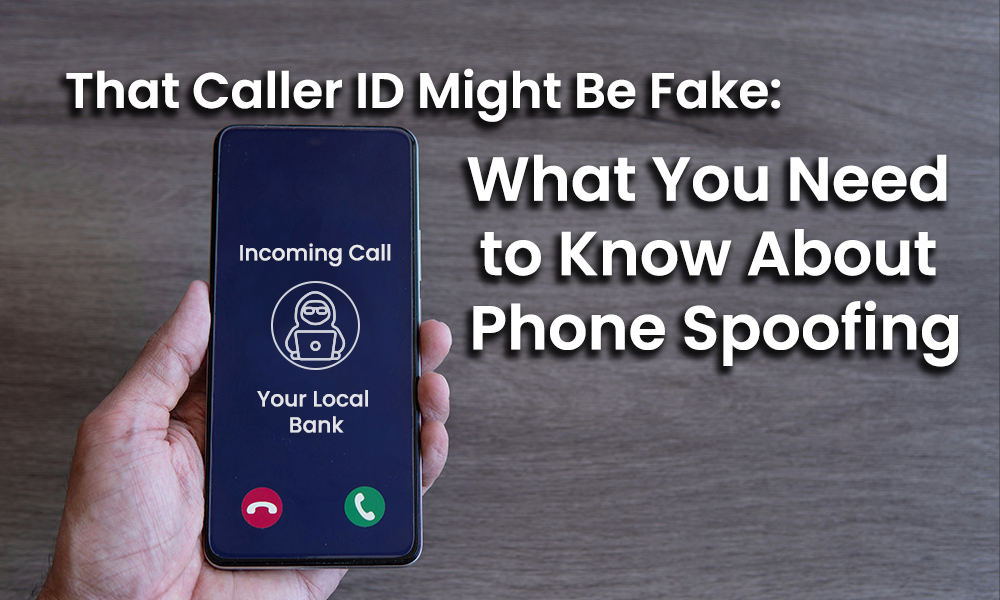
Your office phone rings. The caller ID shows the name of a local bank, utility company, vendor, government office, or even another employee in your organization.
It looks legitimate, so you answer.
Unfortunately, the name and number displayed on your phone may not tell you who is actually calling.
Caller ID spoofing allows scammers to manipulate the information that appears when they place a call. They may impersonate a familiar business, a local phone number, a government agency, or another trusted organization to make employees more likely to answer and believe what they are told.
For businesses, this makes training security awareness especially important. Employees need to understand that cybersecurity threats do not arrive only through suspicious emails. Social engineering can happen through phone calls, text messages, email, and other communication channels.
The Federal Trade Commission warns that scammers can make fake names and phone numbers appear on caller ID, including numbers that appear to be local or associated with organizations people already know.
A professional phone system can help your company communicate efficiently, but employees still need the knowledge to recognize when the person on the other end of the call might not be who they claim to be.
What Is Caller ID Spoofing?
Caller ID spoofing is the manipulation of caller ID information so that a different phone number or name appears on the recipient's phone.
Instead of seeing the scammer's actual number, an employee might see something that appears much more trustworthy.
For example, a spoofed call could appear to come from:
- A local business
- Your bank
- A utility provider
- A government agency
- A customer
- A vendor
- A company executive
- A technical support provider
- Another phone number inside your local area
There are legitimate situations where organizations may present a different business number as their outbound caller ID, such as displaying a company's main office number instead of an individual employee's direct number. The security concern occurs when caller ID information is manipulated to mislead someone or support fraudulent activity.
Because caller ID can be altered, employees should never use the displayed phone number as the only way to verify someone's identity.
Why Spoofing Works So Well Against Businesses
Phone calls create a sense of urgency that email often does not.
If an employee receives a suspicious email asking for financial information, they may have time to examine the sender address, wording, and links.
A phone call puts them on the spot.
The caller might say:
- "I'm calling from your bank's fraud department."
- "Your internet service is about to be disconnected."
- "I'm with your IT provider and need remote access."
- "Your account has been compromised."
- "I need the verification code that was just texted to you."
- "This is the owner. I need you to process this payment immediately."
- "We're updating your account and need to confirm your password."
The scammer may already know the employee's name, company name, job title, vendors, or other publicly available information. Knowing those details does not prove the caller is legitimate.
The FTC specifically recommends independently contacting a company using information you know is legitimate rather than trusting the phone number provided by an unexpected caller.
This is exactly the type of situation a strong cyber security awareness program should prepare employees to handle.
Local Caller ID Does Not Mean the Caller Is Local
One particularly effective technique is sometimes called neighbor spoofing.
The incoming number may use the same area code or even similar first digits as the recipient's phone number. That familiar appearance can make the call seem like it came from a nearby customer, supplier, doctor's office, or business.
For organizations serving Northwest Ohio and Southeast Michigan, employees may naturally be more likely to answer numbers with familiar regional area codes because they expect calls from local customers and vendors.
Scammers understand that behavior.
A Toledo-area-looking number does not necessarily mean the caller is actually in Toledo. A Southeast Michigan number does not prove that the caller is located in Michigan.
Employees should focus on what the caller is requesting rather than relying on the location displayed by caller ID.
Phone Scams Are a Form of Social Engineering
When businesses discuss cybersecurity, conversations often focus on antivirus software, firewalls, passwords, and phishing emails.
Those protections matter, but attackers frequently target people instead of technology.
A fraudulent caller may not need to hack into the network if they can convince an employee to simply give them the information they need.
This type of attack can target:
- Usernames and passwords
- Multi-factor authentication codes
- Customer information
- Banking information
- Employee records
- Payment details
- Remote access to computers
- Internal procedures
- Vendor information
- Sensitive company data
That is why IT security awareness should go beyond telling employees not to click suspicious email links.
Employees need practical training that prepares them to recognize suspicious behavior across multiple communication channels.
UNIFY's Security Awareness Training focuses on cybersecurity education, phishing and malware awareness, data protection, simulations, and reporting that helps businesses measure employee progress.
The Red Flags Employees Should Recognize
A phone call should receive additional scrutiny when the caller creates urgency or asks the employee to bypass normal company procedures.
Employees should be cautious when someone unexpectedly asks them to:
- Provide a password
- Read a multi-factor authentication code
- Confirm sensitive account details
- Transfer money
- Purchase gift cards
- Pay through cryptocurrency
- Install remote-access software
- Visit an unfamiliar website
- Download a file
- Change banking information
- Reset another employee's password
- Provide customer or employee information
- Keep the conversation secret
Urgency is another major warning sign.
Statements such as "you need to do this immediately," "your service will be shut off today," or "do not tell anyone else about this" are designed to discourage employees from slowing down and verifying the request.
The FTC warns that scammers commonly use pressure, threats, impersonation, and unusual payment requests to convince people to act quickly.
Create a Simple Verification Process
One of the best defenses against phone impersonation is giving employees a clear process they can follow.
If a caller requests something sensitive, the employee should be allowed to stop the conversation and independently verify the request.
A practical process might look like this:
- Do not provide sensitive information immediately.
Employees should avoid providing passwords, verification codes, financial information, or confidential company information during an unexpected call.
- Get the caller's basic information.
Ask for the person's name, company, department, and reason for calling.
- End the call if verification is needed.
Employees should feel comfortable telling the caller they will call back through an established company number.
- Find the correct number independently.
Use an existing vendor contact, official website, recent statement, company directory, or another trusted source.
Do not simply call the number shown on caller ID.
- Report suspicious calls internally.
Employees should know who to contact when something feels wrong, whether that is a manager, IT provider, security contact, or another designated person.
The goal of training security awareness is not to make employees afraid to answer the phone. It is to give them a repeatable process for handling unusual requests.
Your Phone System Still Plays an Important Role
Employee education is critical, but the phone system itself also affects how efficiently businesses manage communications.
Modern business phone systems can provide professional call routing, extension management, voicemail, and other features that help organizations control how incoming and outgoing calls are handled.
Cloud platforms can provide even greater flexibility.
UNIFY's U-Reach Cloud PBX supports centralized call management across desk phones, computers, web browsers, and mobile devices while providing features such as call routing, extension management, reporting, and centralized communication tools.
These capabilities can improve business communications, but no phone platform can completely replace employee judgment.
A legitimate-looking caller ID can still be misleading. Technology and training need to work together.
Security Awareness Training Should Include Phone Calls
Many employees associate cybersecurity training almost exclusively with phishing emails.
That leaves an important gap.
Employees interact with customers, vendors, financial institutions, support providers, and coworkers over the phone every day. An attacker who understands those relationships may be able to construct a convincing story.
Effective training security awareness should teach employees to recognize social engineering whether it arrives through email, phone, text, or another communication method.
UNIFY's broader managed IT service takes this layered approach by combining technology protection with ongoing cybersecurity awareness training and behavioral reinforcement.
For businesses throughout Northwest Ohio and Southeast Michigan, that training can be especially valuable because employees regularly interact with local vendors, customers, banks, municipalities, and service providers. Familiar names and local phone numbers can make an impersonation attempt seem much more believable.
Build a Culture Where Employees Verify Before They Trust
One of the most important parts of cyber security awareness is making verification normal.
Employees should not worry that they are being difficult by questioning an unexpected request.
If someone claiming to be the company president asks for an unusual payment, verify it.
If someone claiming to be IT asks for a password, verify it.
If a bank calls asking for account information, verify it independently.
If caller ID displays a familiar number but the conversation does not feel right, verify it.
The few minutes required to confirm a request can prevent a much larger security incident.
Businesses can reinforce these habits through regular it security awareness training, internal procedures, simulations, reminders, and management support.
Our article The Human Side of Cybersecurity: Why Cybersecurity Awareness Training Matters explains why ongoing employee education should be part of a broader cybersecurity strategy.
Protect the Technology and the People Using It
Modern business phone systems make it easier than ever for employees to stay connected, whether they are using desk phones, computers, mobile devices, or cloud-based communications.
Unfortunately, scammers can use those same communication channels to reach employees.
The name on caller ID should be treated as information, not authentication.
Businesses need reliable phone technology, strong security tools, and employees who understand how social engineering works.
Unify Marketing & Technology Solutions helps organizations throughout Northwest Ohio and Southeast Michigan improve both sides of that equation with business phone solutions, cloud communications, managed IT services, and training security awareness designed to help employees recognize and respond to modern threats.
Technology protects your systems. Educated employees help protect everything technology cannot.
Frequently Asked Questions
What is caller ID spoofing?
Caller ID spoofing is the manipulation of caller identification information so a different name or phone number appears to the person receiving the call. Scammers may use spoofing to impersonate businesses, government agencies, banks, or familiar local numbers.
Can a scammer make a real company's phone number appear on caller ID?
Yes. The FTC warns that scammers can fake caller ID information and make calls appear to originate from companies, government organizations, or other trusted sources.
Does a local caller ID mean the caller is nearby?
No. Scammers can spoof local numbers to increase the likelihood that someone answers. The FTC identifies this technique as neighbor spoofing.
What should an employee do if a suspicious caller asks for sensitive information?
Do not provide the information immediately. Get basic details, end the call if necessary, and independently contact the organization through a phone number or communication method you already know is legitimate.
Should employees ever give a verification code to someone who calls them?
Employees should not provide account verification or multi-factor authentication codes to an unexpected caller. If there is any question about a request, employees should stop and verify it through an established contact.
How does training security awareness help prevent phone scams?
Training security awareness teaches employees to recognize social engineering tactics such as impersonation, urgency, suspicious requests, and attempts to obtain sensitive information. It also gives employees a clear process for verifying unusual requests.
Is phone spoofing considered a cybersecurity issue?
It can be. Spoofing is frequently used as part of social engineering attacks designed to obtain passwords, financial information, remote access, or other sensitive information. Businesses should include suspicious phone calls in their broader cyber security awareness program.
Can a business phone system completely stop caller ID spoofing?
No phone system can make caller ID alone a reliable proof of identity. Modern telecommunications providers use tools to combat fraudulent and unwanted calls, but employees should still verify sensitive requests instead of relying solely on the displayed caller ID.
What should we do if scammers are spoofing our company's phone number?
Document the reports you receive, contact your phone provider, and consider filing a report with the FCC. Let employees know what is happening so they can respond consistently to customers who may call back about fraudulent calls.
How often should employees receive security awareness training?
Security awareness should be ongoing rather than treated as a one-time event. Regular education, simulations, reminders, and updates help employees stay familiar with changing social engineering techniques and reinforce secure behavior.