


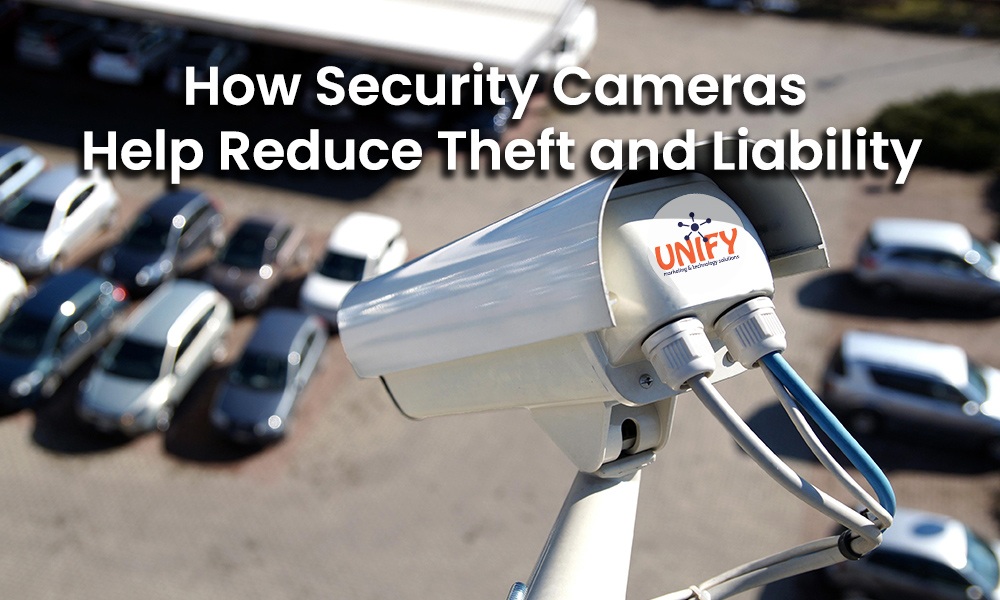
Security cameras are no longer just for catching someone after a break-in.
For businesses, a properly planned camera system for business can help discourage theft, improve employee and visitor safety, document incidents, support insurance claims, and provide valuable evidence when there is a dispute.
That makes video surveillance an important part of overall facility security.
At Unify Marketing & Technology Solutions, we help businesses throughout Maumee, Toledo, Perrysburg, Sylvania, Northwest Ohio, and Southeast Michigan design and install security systems that improve visibility across their properties.
The key is not simply installing cameras. Effective surveillance requires good camera placement, reliable recording, proper retention, remote access, and a system designed around the actual risks of the facility.
Here is how security cameras can help reduce both theft and liability for businesses.
Security Cameras Can Help Deter Theft Before It Happens
One of the most valuable benefits of a camera system for business is deterrence.
People are generally more likely to reconsider theft, vandalism, or other inappropriate behavior when they know their actions may be recorded.
Visible cameras can help discourage:
- Shoplifting
- Employee theft
- Vandalism
- Unauthorized entry
- Equipment theft
- Package theft
- Vehicle-related incidents
- After-hours activity
For some businesses, simply increasing visible surveillance coverage around entrances, inventory areas, parking lots, and other sensitive locations can help improve facility security.
Cameras should not be treated as a substitute for good access controls, policies, lighting, or other security measures. Instead, they work best as one part of a larger physical security strategy.
UNIFY provides professional security camera installation along with access control and other business security solutions.
Video Gives Businesses a Record of What Actually Happened
When an incident occurs, one of the hardest questions is often surprisingly simple:
What actually happened?
Without video, businesses may have to rely on conflicting accounts from employees, customers, visitors, or witnesses.
A security camera system can provide an objective record of the event.
For example, imagine a customer reports that they slipped near the front entrance and claims the floor had been wet for an extended period.
Recorded footage may help determine:
- When the customer entered
- Whether there was a visible spill
- How long the condition existed
- Whether employees had inspected the area
- What occurred immediately before the fall
- Whether warning signs were present
- Whether anyone else had encountered the same condition
This type of information can be extremely useful when responding to liability claims.
A properly installed camera system for business creates a record that can help business owners, managers, insurance providers, and legal professionals better understand an incident.
Security Cameras Can Help Protect Against False Claims
Not every liability claim accurately reflects what happened.
Businesses sometimes encounter disputes involving injuries, property damage, employee behavior, vehicle accidents, damaged merchandise, or interactions between employees and customers.
Without evidence, it may become one person's word against another's.
Video footage can provide important context.
A recorded incident may show that events occurred differently than initially reported. It may also confirm that a claim is legitimate, allowing the business to respond appropriately rather than spending unnecessary time disputing what happened.
This makes surveillance useful for more than traditional theft prevention.
A good camera system for business can support risk management by documenting activity throughout key areas of the facility.
Cameras Can Help Reduce Employee Theft
External theft receives a lot of attention, but businesses also need to consider internal loss.
Inventory, equipment, cash, tools, materials, and other assets can disappear without an obvious explanation.
A security camera system can help businesses monitor areas where valuable items are stored or handled.
Depending on the business, these areas may include:
- Stockrooms
- Warehouses
- Loading docks
- Cash registers
- Storage rooms
- Equipment areas
- Shipping and receiving
- Server or technology rooms
- Supply areas
The goal should not be to create an environment where employees feel constantly watched.
Instead, surveillance can provide accountability in areas where the business has a legitimate security concern.
Professional security camera installation also helps make sure cameras are positioned where they provide useful coverage rather than simply recording large areas without enough detail.
Camera Placement Matters More Than Camera Count
A common mistake is assuming that more cameras automatically mean better security.
They do not.
A building with twenty poorly positioned cameras may have worse coverage than another facility with twelve cameras that were carefully planned.
Camera placement should account for how people move through the property and where incidents are most likely to occur.
Important locations often include:
- Main entrances and exits
- Employee entrances
- Loading docks
- Parking lots
- Reception areas
- Inventory rooms
- Hallways
- Cash handling areas
- Exterior doors
- Delivery areas
- Server rooms
- Restricted areas
Camera height and angle also matter.
A camera mounted too high may show that someone entered a building without providing enough detail to identify them. Another camera may point toward a doorway but become overwhelmed by bright exterior lighting.
Effective facility security requires reviewing sightlines, lighting, obstructions, and potential blind spots before installation.
UNIFY's security services include system design, camera placement, recording configuration, and remote viewing capabilities.
Blind Spots Can Create a False Sense of Security
Having cameras does not necessarily mean every important area is covered.
Shelving, doors, walls, equipment, trees, signs, vehicles, and even new office layouts can create blind spots.
A camera may have provided excellent coverage when it was originally installed, but changes to the building can reduce its effectiveness over time.
Businesses should periodically review surveillance footage and ask:
Can we clearly see the entrance?
Can we identify someone approaching the building?
Can we see what happens at the loading dock?
Are there areas where inventory disappears from view?
Would this footage actually be useful if an incident occurred?
Those questions can reveal weaknesses before an actual security event exposes them.
A good camera system for business should be reviewed as the facility changes.
Security Cameras Can Support Access Control
Surveillance becomes even more useful when combined with access control.
An access control system can record that a credential was used at a particular door at a particular time.
A camera can show who actually used it.
Together, the systems provide greater visibility into what is happening around secured entrances.
For example, an access control log might show that an employee credential opened a restricted door at 8:14 p.m.
Video footage can help determine whether that employee used the credential, whether someone followed them through the door, and what happened afterward.
UNIFY offers access control systems that can be combined with surveillance to create a more complete facility security strategy. Modern access control can also help businesses manage credentials, monitor entry activity, and reduce dependence on traditional keys.
Cameras Can Help With Parking Lot and Vehicle Incidents
Business liability does not stop at the front door.
Parking lots can create their own challenges.
Vehicle collisions, vandalism, theft, pedestrian incidents, and disagreements over who caused damage can all happen outside the building.
Exterior cameras can help document:
- Vehicles entering or leaving
- Parking lot accidents
- Damage to company vehicles
- Unauthorized parking
- After-hours visitors
- Loading and unloading activity
- Suspicious behavior near employee vehicles
Businesses with large parking lots, warehouses, manufacturing facilities, and loading areas may need different cameras than a small office.
Lighting, distance, weather exposure, and identification requirements all need to be considered during security camera installation.
Recorded Video Can Improve Incident Response
When something happens, managers need information quickly.
Modern surveillance systems can allow authorized users to review recorded footage without physically standing in front of a recorder.
Remote viewing can help owners and managers check what is happening at the facility from a computer or mobile device.
That can be useful when responding to:
- Alarm notifications
- After-hours activity
- Access control alerts
- Employee concerns
- Deliveries
- Property damage
- Suspicious vehicles
- Security incidents
UNIFY's security solutions include remote monitoring and recorded footage access so businesses can maintain better visibility over their facilities.
Video Retention Is an Important Part of the System
A camera only helps after an incident if the video still exists.
Businesses should think carefully about recording retention.
A company may not discover missing inventory until several days later. A liability claim may not be reported immediately. An employee may notice property damage long after it happened.
If the recording system only retains a short period of footage, the video needed to investigate the incident may already be gone.
Retention depends on factors such as:
- Number of cameras
- Camera resolution
- Recording frame rate
- Motion versus continuous recording
- Available storage
- Business requirements
During security camera installation, businesses should discuss how long they want footage retained and make sure the recording system is sized appropriately.
Security Cameras Help Protect More Than Merchandise
When businesses think about theft, they often think about retail inventory.
But nearly every organization has assets worth protecting.
A medical office may need to protect equipment and sensitive areas.
A manufacturing facility may have valuable tools, materials, and machinery.
An office may have computers, networking equipment, documents, and employee belongings.
A warehouse may need visibility over inventory and shipping activity.
A school or municipal facility may be more focused on safety and controlling unauthorized access.
That is why facility security should be designed around the specific environment.
There is no universal camera layout that works equally well for every business.
Professional Installation Can Improve Reliability
Security cameras have become easier to purchase, but commercial surveillance requires more planning than simply mounting cameras and connecting them to WiFi.
A professional installation may need to consider:
- Network bandwidth
- Power requirements
- PoE switches
- Camera resolution
- Storage capacity
- Weather protection
- Cable routes
- Network segmentation
- Remote access
- User permissions
- Camera positioning
Since modern IP cameras rely on the business network, the quality of the underlying infrastructure matters too.
UNIFY provides network cabling and wiring services for cameras, wireless access points, phones, computers, access control systems, and other connected devices.
Good cabling and network design can make a significant difference in the reliability of a surveillance system.
Local Businesses Have Different Security Needs
Security needs can vary significantly from one property to another.
An office in Maumee may need coverage around entrances, a parking lot, and a small equipment room.
A warehouse in Toledo may need cameras across loading docks, inventory aisles, and exterior vehicle areas.
A manufacturer in Perrysburg or Bowling Green may need surveillance across production areas, secured entrances, storage locations, and multiple buildings.
Businesses in Sylvania and communities throughout Northwest Ohio may also need to integrate surveillance with access control, network infrastructure, or other security systems.
The same applies to organizations across Southeast Michigan.
A professional camera system for business should be designed around the property rather than using the same package for every location.
A Camera System Is Part of a Bigger Security Strategy
Security cameras are powerful tools, but they are most effective when they work alongside other protections.
A complete facility security strategy may include:
- Security cameras
- Access control
- Electronic door locks
- Intercom systems
- Alarm systems
- Proper lighting
- Network security
- Visitor policies
- Employee security procedures
UNIFY combines security camera installation and access control to give businesses both visibility and greater control over who can access different areas of a property.
Instead of treating each security system as a separate project, businesses can benefit from planning how the pieces work together.
Protect Your Business With Better Visibility
A security incident can create more than a financial loss.
It can interrupt operations, create liability concerns, damage customer relationships, and leave business owners trying to reconstruct what happened without enough information.
A well-designed camera system for business helps provide that missing visibility.
It can discourage theft, document incidents, support liability investigations, monitor sensitive areas, and provide evidence when questions arise.
For businesses throughout Maumee, Toledo, Perrysburg, Sylvania, Bowling Green, Northwest Ohio, and Southeast Michigan, professional security camera installation can become an important part of a larger facility security plan.
The objective is not simply to record your property.
It is to make sure that when something happens, your business has the information it needs to understand what happened and respond appropriately.
Frequently Asked Questions
Why should a business install security cameras?
Security cameras can help deter theft, vandalism, unauthorized entry, and other unwanted activity. Recorded footage can also provide valuable evidence when investigating accidents, liability claims, employee incidents, or property damage.
What is the best camera system for business use?
The best camera system depends on the size and layout of the facility, lighting conditions, required image detail, retention requirements, remote viewing needs, and areas being monitored. A professional assessment can help determine the appropriate cameras and recording system.
What does professional security camera installation include?
Professional security camera installation can include system design, camera placement, network and cabling requirements, camera mounting, recorder configuration, storage setup, remote viewing, and system testing.
Can security cameras help reduce business liability?
Security cameras can provide recorded evidence of accidents, customer interactions, vehicle incidents, property damage, and other events. This footage may help businesses and their insurance or legal representatives establish what occurred.
How long should a business keep security camera footage?
The appropriate retention period depends on the business and the purpose of the surveillance system. Storage capacity, number of cameras, resolution, recording settings, and how quickly incidents are typically discovered should all be considered.
Can security cameras integrate with access control?
Yes. Access control and video surveillance can complement each other by combining door activity records with recorded video. This can provide better insight into who entered a secured area and what happened afterward.
Where should businesses install security cameras?
Common areas include entrances, exits, parking lots, loading docks, inventory areas, hallways, reception areas, cash handling locations, equipment rooms, and other sensitive or high-traffic areas.
Does UNIFY provide security camera installation in Northwest Ohio?
Yes. UNIFY provides security camera and physical security solutions for businesses in Maumee, Toledo, and surrounding communities throughout Northwest Ohio. UNIFY also serves businesses in Southeast Michigan.