


Ransomware attacks are no longer rare, large enterprise events you read about in national headlines. They are happening every day to small and midsize businesses, including organizations right here in Northwest Ohio.
At Unify Marketing & Technology Solutions, we work with companies that depend on their technology to operate. Phones, servers, file shares, accounting systems, line of business applications, remote access, all of it must function every day. When ransomware attacks hit, everything stops.
Here is what a ransomware attack actually looks like in real life.
A Real-Life Scenario: Monday Morning at a Mid-Size Manufacturing Company
It is 8:07 a.m. on a Monday.
An office manager at a 25 person manufacturing company opens an email that appears to come from a long time vendor. The subject line reads: “Updated Invoice – Urgent Review Required.”
The email looks legitimate. The logo is correct. The tone matches previous communications. There is a PDF attachment.
The employee opens the file.
Nothing appears unusual. The document looks blank for a moment, then displays an error message stating that the file cannot be previewed. Assuming it is a glitch, the employee closes it and moves on.
What just happened is the first stage of a ransomware attack.
Stage 1: Silent Installation
Behind the scenes, malicious code embedded in that attachment has executed. It reaches out to an external server and downloads a ransomware payload.
Within minutes:
- The infected computer begins scanning the network
- It looks for shared folders
- It searches for mapped drives
- It checks for backup locations
- It attempts to harvest stored credentials
Most ransomware attacks today are not random smash and grab events. They are methodical. They look for ways to maximize impact before revealing themselves.
The attacker now has a foothold inside the network.
Stage 2: Lateral Movement
Over the next several hours, the ransomware spreads.
It uses stolen credentials to access:
- The accounting server
- The shared drive used by production
- The HR file repository
- The on premises file server
If administrative passwords are weak or reused, the spread accelerates.
By lunchtime, multiple systems are compromised. Employees may notice minor slowdowns, but nothing alarming.
This is typical of modern ransomware attacks. They stay quiet until maximum damage is possible.
Stage 3: Encryption and Lockout
At 3:42 p.m., everything changes.
Files across the network begin to encrypt. Spreadsheets will not open. Customer contracts display errors. The ERP system fails to launch.
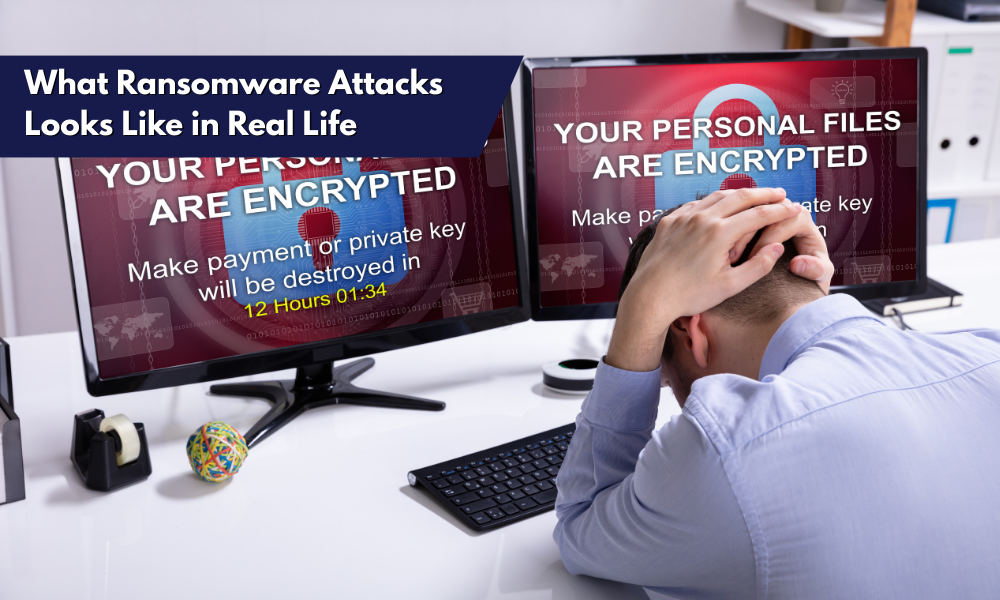
Then the ransom note appears on every screen.
It reads:
Your files have been encrypted.
To recover your data, you must pay 3.2 Bitcoin within 72 hours.
If payment is not received, your data will be permanently deleted and publicly released.
Phones start ringing internally. The accounting team cannot process payments. Production cannot access job files. Management cannot retrieve customer data.
Business operations stop immediately.
This is what ransomware attacks actually look like in real life. They are chaotic, stressful, and fast moving.
The Immediate Impact
Within the first 24 hours, the company faces:
- Complete operational downtime
- Inaccessible financial records
- Potential data breach exposure
- Customer service disruption
- Regulatory reporting requirements
- Reputational risk
Even if the ransom is paid, there is no guarantee that files will be fully restored. In many cases, data is corrupted or partially unrecoverable.
The average cost of recovery can include:
- Incident response services
- Forensic investigation
- Legal consultation
- System rebuild and reconfiguration
- Lost revenue during downtime
For small and midsize businesses, this can be devastating.
Why Ransomware Attacks Succeed
Most ransomware attacks succeed due to a combination of factors:
- Lack of employee security awareness training
- Weak password practices
- No multi factor authentication
- Unpatched systems
- Improperly secured backups
- Limited network segmentation
It is rarely one single failure. It is usually a chain of small vulnerabilities that create a path for attackers.
What Preventing Ransomware Attacks Really Means
Preventing ransomware attacks requires a proactive, layered approach. It is not about installing one antivirus solution and hoping for the best.
At Unify MTS, we focus on practical, business ready security strategies that include:
- Security Awareness Training
Employees are the first line of defense. Ongoing training helps them recognize phishing emails, suspicious attachments, and social engineering tactics before they click.
- Endpoint Protection and Monitoring
Advanced endpoint detection and response tools monitor for unusual behavior, not just known malware signatures.
- Multi Factor Authentication
Even if credentials are stolen, multi factor authentication can prevent attackers from accessing critical systems.
- Proper Backup Strategy
Backups must be:
- Regularly tested
- Stored off site or in immutable storage
- Segmented from the primary network
If backups are connected to the network without protection, ransomware will encrypt them too.
- Patch Management
Outdated systems are prime targets. Regular updates close known security gaps.
- Network Segmentation
Separating critical systems limits how far ransomware can spread if one device is compromised.
Preventing ransomware attacks is about building multiple barriers so that one mistake does not become a catastrophic event.
The Recovery Reality
In many real world cases, companies that recover successfully have:
- A documented incident response plan
- Reliable, tested backups
- Professional IT support ready to act immediately
Organizations without these often spend weeks rebuilding from scratch.
The difference between a temporary disruption and a business ending crisis often comes down to preparation.
Preparation Is the Difference
Ransomware attacks are not abstract cyber threats. They are real, operational events that shut down businesses, freeze revenue, and damage trust.
Understanding what a ransomware attack actually looks like is the first step toward taking it seriously.
The next step is action.
At Unify Marketing & Technology Solutions, our goal is simple. We help businesses stay operational, secure, and prepared. Cybersecurity is not about fear. It is about protecting the systems your organization relies on every day.
If you are unsure where your vulnerabilities are or whether your current setup would withstand a ransomware event, now is the time to evaluate it, not after an attacker forces the issue.
Prepared businesses recover. Unprepared businesses struggle.
The difference is planning.
Recent Comments